Author: user

  • Introducing Debtmerica’s Debt Options Calculator

    Introducing Debtmerica’s Debt Options Calculator

    Debt Options Calculator

    Compare Your Options

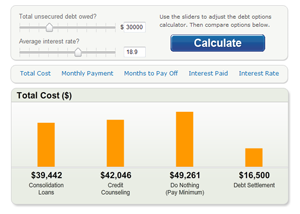
    There are many options when it comes to addressing your debt problems, and now you can compare them with Debtmerica’s Interactive Debt Options Calculator.

    Our easy to use debt options calculator, allows you to take a look at debt settlement and how it compares against other options such as credit counseling, debt consolidation or minimum payments. You’re able to compare Total Cost, Monthly Payment, Months to Pay Off, Interest Paid, and Interest Rate for each option in one easy to read interface. You’re also able to adjust your total debt and average interest rates to tailor our results to your situation.

    Try out Debtmerica’s Debt Options Calculator today and then speak with one of our professionally certified debt consultants to get started on your future free from debt!

  • Debtmerica Debt Calculator

    Use our interactive debt calculator to see how much you could reduce debt with one low monthly payment. For a free evaluation from a professional debt consultant, fill in our 30 second savings quote form.

    +Assumes program completion and does not guarantee results

  • How to Settle Your Debts On Your Own

    How to Settle Your Debts On Your Own

    A Step-By-Step Guide to Settle Debts On Your Own

    Settle Debt With Credit Card Companies

    If you cannot pay the minimum on your debts, it’s time for you to settle your debts. Debt settlement is a way by which you can negotiate with creditors/collection agencies to reduce your debt amount by 40-60%. If you enroll in Debtmerica’s Debt Resolution Program, professional debt consultants will guide you through the debt settlement process and our skilled negotiators will do their best to secure the lowest possible settlement. However, it is possible to tackle the debt settlement process on your own. This article will give you a step-by-step analysis on how to settle your debts yourself. Also, make sure to review our article “The Pros and Cons of Settling Debt Yourself”.

    (more…)

  • Consumers increasingly optimistic about U.S. economy, survey says

    New RBS data shows an increase in consumers' economic confidence Americans’ opinions regarding the economy are steadily becoming more favorable as they begin to be less pessimistic about their local economies, likely leading to a decreased need for some to consolidate debt and save their finances.

    The latest RBC Consumer Outlook Index released on Thursday showed an increase of 8.1 points as it hit 72.7 in May, led primarily by an increasing confidence in an economic recovery as well as an improved job market.

    Overall, 31 percent of consumers felt that the economy would likely improve in the next year, more than the 26 percent who feel it will become worse but less than the 43 percent who expect it to stay the same.

    "This month’s RBC Consumer Outlook Index shows that consumers’ negative attitudes are moving towards neutral, but not yet into positives – they are not yet ready to say that things have gotten better, especially when it comes to the national economy," said Marc Harris, co-head of global research at RBC Capital Markets. "Few Americans are ready to say they are enjoying good times."

    Despite the improved sentiments, 49 percent of consumers still described their personal financial situation as bad compared to three months ago, up from 45 percent who said so in April.

  • Restaurants sales data shows increases in March

    Restaurant sales increased at the end of the 2010's first quarter Likely spurred by some indicators of an economic rebound, newly released restaurant sales data for the end of 2010’s first quarter show significant improvements that may indicate consumers are not as reliant on debt consolidation tactics as they once were.

    The latest Restaurant PerformanceIndex released by the National Restaurant Association last week saw a notable increase of 1.4 percent to hit 100.5 in March compared to the previous month’s figures.

    The monthly increase in the index above 100 for the first time in 29 months and to its highest level since September 2007.

    "The RPI’s solid performance in March was driven by improvements among both the current-situation and forward-looking indicators," said Hudson Riehle, senior vice president of the Research and Knowledge Group for the association. "Restaurant operators reported net gains in both same-store sales and customer traffic in March, the first time in 31 months that both indicators stood in positive territory."

    Additionally, the NRA’s Current Situation Index, which measures current trends in same-store sales, traffic, labor and capital expenditures, hit 99.0 during March, a 2.4 percent increase from February’s figures. While same-store sales and traffic indicators increased during the month, labor and capital expenditure indicators continued to lag and decline.

  • Personal income increases in March, says BEA

    Personal income increased in March New government figures released at the start of May have found that the end of 2010’s first quarter saw widespread gains in most figures relating to consumer income, signaling that Americans may not be as strapped for cash and in need of debt consolidation as they have been in recent months.

    According to newly released data from the U.S. Bureau of Economic Analysis, personal income increased by $36 billion in March representing a 0.3 percent increase over the previous month’s figures.

    Along with an increase in the amount of money finding its way into the bank accounts of consumers across the country, so too did the amount of extra cash that Americans had to spend. The BEA’s March figure for disposable personal income also saw an increase of $32.3 billion, a 0.3 percent increase from the previous month’s figures.

    The BEA also found that private wage and salary disbursements for the month also saw an increase of $11.8 billion for the month, nearly double the $6.8 billion increase in the figure seen in February.

    Goods-producing industries’ payrolls were also able to nearly offset a $3.3 billion decrease recorded in February as they increased by $2.2 billion in March.

  • Bankrate: Mortgage rates remain stable

    Mortgage rates remained stable for the second half of April Average interest rates for all mortgage types remained somewhat stable and showed minimal declines in the second part of April, continuing low rates that could be utilized to consolidate debt for homeowners looking to refinance.
    According to the latest weekly national survey released by Bankrate.com on Thursday, the average rate for 30-year fixed-rate mortgages decreased slightly by 0.01 percentage points to hit 5.21 percent for the week ending April 21. While a decline, the rate change was minimal compared to the 0.14 percentage point decline seen one week prior.

    Similarly, the average rate for 15-year FRMs declined by 0.01 percentage points as well, falling to 4.54 percent for the week. The mortgage type had also seen a more sizable decline of 0.13 percentage points one week earlier as well.

    The average rate for 5/1-year adjustable-rate mortgages saw the largest decrease of the week as it fell by 0.05 percentage points to hit 4.37 percent. The week prior, the rate had seen a drop of 0.07 percentage points.

    With the slight rate decreases, a $200,000 loan taken out in November 2008 that was refinanced under the current conditions would reduce mortgage payments by $142 every month as it fell to $1,099.46.

  • Debtmerica’s Guide To Debt Settlement

    Debtmerica’s Guide To Debt Settlement

    Debt Resolution Alternatives

    Debt Resolution Alternatives

    There are many options when it comes to addressing your debt problems. Debtmerica believes it provides a better alternative to Consumer Credit Counseling, Bankruptcy or Debt Consolidation Loans.

    Take a minute to watch this educational video about the various options available to you.

    (more…)

  • Mortgage fraud increased in 2009, says LexisNexis

    Mortgage fraud is on the rise, according to a new survey As homeowners struggling with their finances look to consolidate debt any way possible, including through mortgage refinancing, they should be aware that mortgage fraud cases rose yet again in 2009.

    According to the latest report released Monday by LexisNexis’ Mortgage Asset Research Institute, incidents of mortgage fraud and misrepresentations by industry professionals increased by 7 percent from 2008 to 2009 in the U.S.

    The increase was less than the 26 percent increase in mortgage fraud seen the year prior, with experts adding that the year-by-year percentage difference may not be as wide as the data indicates.

    "While this is a noticeable increase, we believe that mortgage fraud is significantly understated, even during times of massive origination volumes," said Jennifer Butts, LexisNexis Mortgage Asset Research Institute manager of data processing.

    "Lenders are facing hurdles with compliance, loss mitigation and staving off additional financial losses due to poor loan performance," added Denise James, LexisNexis Risk Solutions director of real estate solutions.

    After holding the unfortunate title of the state with the highest rate of mortgage fraud for two of the last three years, Florida again overtook Rhode Island in 2009 as its residents suffered through three times the expected amount of fraud cases.

  • Join Debtmerica On Facebook and Twitter

    Join Debtmerica On Facebook and Twitter

    Debtmerica is now on Facebook and Twitter! Become a Facebook fan by clicking here and stay plugged into Debtmerica. You can also follow us on Twitter. We hope to connect with you soon.