Blog
-
Two-thirds of Americans to be affected by economy this holiday season
 Supporting the many studies that have indicated the 2009 holiday season will see consumers who stress consolidation and frugality over frivolous spending, a new survey from the National Retail Federation (NRF) has found that two-thirds of American families will be affected by the current economic situation
According to the survey, which was conducted for the NRF by BIGresearch, 65.3 percent of respondents said that the economy would be affecting their holiday plans this season in some way. Of those, 84.2 percent said that they were planning on spending less money, while 55 percent said that they would be more wary for sales and 41.7 percent said they would increase their usage of coupons.
Additionally, there were a larger percentage of respondents (70.1 percent) who said they would consolidate debt by shopping at discount stores this holiday season than by shopping on the internet (42.4 percent), at clothing stores (33.8 percent), or electronics stores (31.8 percent).
"While last holiday season was filled with chaotic confusion, adjusting to uncertainty has now become routine for many Americans," said NRF president and CEO Tracy Mullin. "This holiday season will be a bit of a dance between retailers and shoppers, with each group feeling the other out to understand how things have changed and how they must adapt."
In a previous survey, the NRF predicted that overall holiday sales would total $437.6 billion, a 1 percent drop from 2008 figures.
-
Save cash, make your holiday plans ASAP
 Even those struggling through their finances in some way, such as consumer credit counseling, need to find a way home for the holidays. Because of that, experts are urging travelers to lock their plans in now in order to avoidpaying top dollar in what looks to be a very hit-or-miss season when it comes to travel prices.
Unlike the holiday season last year, air travel for the 2009 season stands to see price hikes as the holidays approach due to 3.4 percent fewer flights taking off this season, according to Arlington, Virginia television affiliate Newchannel 8 recently reported.
According to FareCompare.com CEO Rick Seaney, the decrease in availability means that prices will not drop at the last minute like they did in 2008 and travelers should be proactive in making their travel plans as soon as possible.
"Bottom line is that holiday-travel procrastinators do so at their own peril this year, and practical travelers should be shopping now and buying before the end of October," he said, according to the Columbus Dispatch.While a forecast for the upcoming season on Microsoft’s Bing Travel also urged consumers to plan ahead as well – saying that "the likelihood of fares continuing to increase as we near the holiday season far outweighs the likelihood of fares dropping significantly."
However, it added that there were deals to be had by consumers that outweighed those seen in 2008, noting that ticket prices for a traditional Thanksgiving holiday itinerary currently averaged $375, down $122 from last year.
-
Customers can save money by going green this holiday season
 For those in consumer credit counseling, every cent counts. Because of that, new savings plans rolled out by CVS and Target that rewards customers for "going green" at their retail locations this holiday season.
CVS was the first retailer to announce their plan last week, which will give their ExtraCare members $1 in savings for every four times they bring their own bags instead of requesting plastic bags.
Reward program members will be able to participate in the program by purchasing a 99-cent tag to place on their bags that are scanned after every purchase.The program will be implemented at 7,000 of the stores nationwide initially, with the money from the tags being donated to an ecological cause, according to the Providence Journal.
Target, which is the nation’s fifth-largest retailer and sees more than 1.5 billion transactions every year, announced their own green savings plan on Monday that will go into effect at 1,700 of their stores on November 1. According to USA Today, customers who use their own bags to carry their purchases will receive a 5 cent discount for every reusable bag they utilize.
"We reward customers for doing good things," Melissa Studzinski, Target’s director of relationship marketing, told USA Today.
-
MBA: Unemployment won’t peak until mid-2010
 While those facing debt consolidation and warding off bankruptcy may be pleased by assertions from the Mortgage Bankers Association (MBA) that the economy is improving, they also must brace for the fact that it may not be felt until later in 2010.
The predictions, from the association’s chief economist Jay Brinkmann, warned consumers not tolend too much credence to economic growth that is seen in the final quarter of 2009. While growth may occur through the holiday season, the MBA predicted that it would slow in the first half of 2010.
Additionally, the MBA predicted that the unemployment rate, which currently stands at 9.8 percent, would peak at 10.2 percent by mid-2010.
"The recession is behind us but the effects of the recession will linger for some time in the form of higher unemployment, and lower levels of business investment and home construction," said Brinkmann, before adding that the economy would grow or contract depending on consumer activity.
"The large losses of consumer wealth in the form of reduced home values and stock market losses, as well as the absolute losses of income resulting from unemployment, reduced employment and the fear of unemployment have constrained consumer spending," he added.
On a more optimistic note, Brinkmann said that the implementation of the federal stimulus package and the eventual peak of unemployment would lead to the resumed growth of the economy for the second half of 2010.
-
Bank of America to ‘test’ annual fee on 1% of credit customers
 Bank of America (BOA) may have promised not to raise its interest rates before the implementation of the Credit Card Accountability Responsibility and Disclosure (CARD) Act next February, but apparently implementing new fees is still fair game.
On Tuesday, Bank of America announced that itwould be sending notices out to 1 percent of its credit card customers stating they would be charged a fee ranging from $29 to $99 in February as part of what spokesperson Betty Reiss called the testing of an annual fee that had not yet been implemented
"We’re testing this to see what the feedback is. In terms of any plans going forward, we haven’t made any decisions," Reiss said.
According to MyBankTracker, the bank also added that the fees were being considered as “response to market changes, new federal laws and regulations, and the increasing costs of providing unsecured credit."
The announcement of the new fee comes one week after Bank of America became one of the first to announce they would not be imposing any "misleading" increases to their card holders’ interest rates in the months before new regulations went into effect in February as part of the Credit CARD act.
-
Labor Dept: Higher number of workers being fired than hired
 A new Department of Labor survey is providing less than stellar news for those in debt collection looking for a job, as U.S. employers are ridding themselves of more employees than they’re hiring and sending jobless workers into the hardest job market in years.
The survey, which measured job openings and labor turnover for the month of August, found that a sizable disparity had become apparent when looking at employment numbers dating back to August 2008. While the data showed that there had been 50.9 million hires over the 12-month period, the total number of job "separations" was significantly higher at 56.1 million.
While the amount of job hires remained relatively stable, dropping from 4.2 million in July to 4 million in August, it also represented a decline of 1.6 million – or 28 percent – since its peak numbers seen back in July 2006.
The same could be said for the number of job openings, which at 2.4 million remained the same from July’s figures. However, the number of openings has dropped by 2.4 million – or 50 percent – from its peak numbers recorded in June 2007.
The Labor Department also found that while there had only been an average of 1.72 unemployed people for every job opening in December 2007, that number had skyrocketed to 6.05 persons per application in July.
-
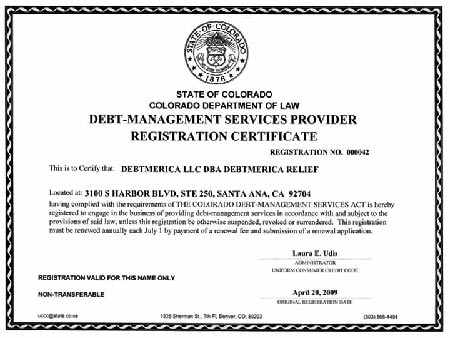
Licensing and Registration
Debtmerica has committed both its time and resources to continually achieve licensing in those states and jurisdictions where required by law. Currently there are only a few states that require licensing or registration and we are proud to say that we will continue to pursue licensing where required.
Colorado

Delaware

Iowa

Utah

-
Economists: Unemployment rate will average 9.9 percent in 2010
 While economists have made it no secret that the unemployment rate will likely rise well into 2010, a new survey from Bloomberg suggests that they may also be worried about what effect it may have on the economy as the country wades through the coming year on its way to recovery.
Drawing onthe 35 percent drop in car sales in August following the end of the Cash for Clunkers, the survey – which polled 57 economists between October 1 and October 8 and took their median forecasts – expressed worry that the economy would still be largely dependent on government funding in order for profits to occur in 2010.
Despite the economists’ forecasts that household spending would increase by 1.5 percent in Q1 2010 before increasing to 1.8 percent in Q2 2010, they also predicted that unemployment would exceed more conservative estimate and exceed 10 percent in Q1 2010 before averaging 9.9 percent for the year.
"You just can’t see a lot of strength on the consumer side given how battered income is from job losses and weak hourly wage growth," David Greenlaw, the chief fixed-income economist at Morgan Stanley & Co., told Bloomberg. "We’ve got a gradual recovery in the overall economy, but it’s not vigorous enough to knock down the unemployment rate by much."
The forecasts were released the same day that the Department of Commerce revealed that a weak dollar and an improving worldwide economy had resulted in a trade deficit of $30.7 billion in August, a $1.2 billion drop from July’s revised figures.
-
Consumers prefer cell phone call in the event of fraud
 In the event of a potentially fraudulent purchase, consumers prefer to be notified directly via a call to their cell phones, according to a new survey released by fraud prevention agency Adeptra.
The extra mode of notification in the event of any type of account breach may be useful to consumers who are dealing with debt counseling and looking to keep a close eye on their finances.
According to the survey, which was conducted in September by polling 200 consumers on how they would like potentially fraudulent transactions to be dealt with, found 54 percent of respondents said that being contacted by a cell phone call was their top choice.
A notably fewer number of respondents, 20 percent, said that they would like to be contacted on their land line telephone. The same percentage of respondents said that they preferred to be notified by email.
Only 6 percent or respondents said that they preferred to be notified by SMS/text message.
"Today’s credit card fraudsters are armed with the combination of no scruples, an eye for opportunity, and cutting edge technologies," said Lou Venezia, the CEO of Adeptra. "It’s a never-ending race but issuers are embracing technologies and services which help them stay one step ahead to protect their brand reputation and, most importantly, let consumers know when there might be fraud so they can stop a small problem from turning into a larger one."
The desire to be contacted directly on a cell phone did not necessarily mean that consumers were overly interested in checking up on their accounts, as only 11 percent said they checked their account balances daily.